
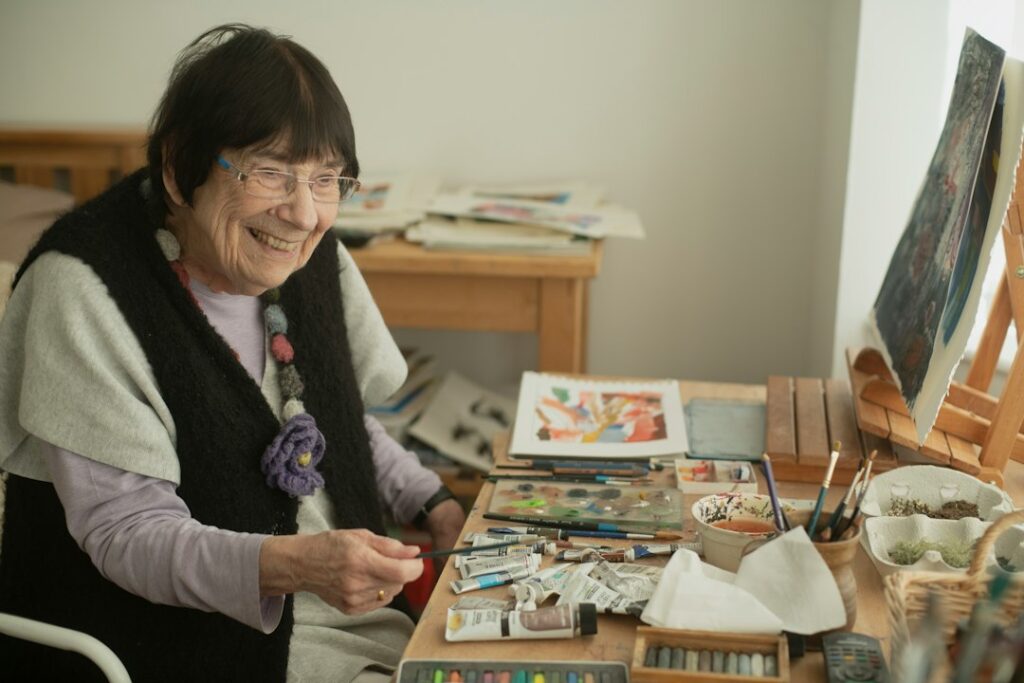
Why does creativity matter in assisted living?
Creative activities support more than entertainment. For older adults in assisted living, making art, writing, singing, gardening, cooking, or working with familiar objects can support emotional well-being, social connection, memory, movement, and a sense of personal identity.
Creativity does not require advanced skills. A resident may enjoy choosing colors, arranging flowers, decorating a seasonal display, telling stories, folding fabric, or listening to music from earlier stages of life. The value comes from having meaningful choices and opportunities to express personal interests.
A strong activity program treats residents as adults with preferences, experience, and opinions—not as people who simply need to be kept busy.
What kinds of creative activities work well for older adults?
The most useful activities are flexible, familiar, and easy to adjust. They should allow residents to participate at different ability levels without making anyone feel tested or judged.
Examples include:
- Watercolor painting, coloring, sketching, and simple printmaking
- Collage projects using fabric, photographs, magazines, or textured paper
- Writing letters, short memories, poems, captions, or family stories
- Singing groups, rhythm activities, music listening, and lyric-based programs
- Seasonal decorating using paper, natural materials, or reusable craft items
- Container gardening, seed-starting, herb care, and flower arranging
- Cooking demonstrations, recipe sharing, and no-bake food preparation
- Knitting, crocheting, weaving, folding, sorting, and other hand-based projects
- Photography, picture displays, and guided reminiscence
- Simple woodworking, model building, or large-piece construction with proper supervision
Activities should not be selected only because they look attractive on a calendar. The better question is whether residents can connect the activity with something they enjoy, remember, or want to learn.
How can activities include residents with different abilities?
Creative programs should offer several ways to participate in the same project. A resident with limited hand strength might choose colors or describe a design while another resident paints. Someone with vision loss may enjoy music, textured materials, scented herbs, or spoken storytelling. A person with memory loss may respond well to familiar songs, repetitive motions, and short steps.
Useful adjustments may include:
- Larger handles, thicker brushes, easy-grip scissors, or lightweight materials
- High-contrast supplies and clear lighting
- Shorter sessions with rest periods
- Demonstrations followed by one step at a time
- Pre-cut materials and partially prepared projects
- Verbal descriptions of colors, shapes, and progress
- Tables arranged for walkers, wheelchairs, and comfortable reach
- Quiet spaces for residents who become overstimulated
Participation should not be measured by whether a project looks finished. Choosing materials, observing others, sharing an opinion, or staying engaged for a few minutes can all be meaningful forms of participation.
How can creativity support memory and identity?
Creative activities often connect present experiences with familiar parts of a person’s life. A resident who once kept a garden may enjoy arranging flowers. Someone who worked with tools may prefer assembling objects. A former teacher may enjoy reading aloud, helping with a group project, or organizing a display.
Reminiscence can be included without turning an activity into an examination. Instead of asking residents to remember exact dates, participants might respond to old household objects, familiar songs, seasonal traditions, or photographs. Open-ended prompts work well:
- “What did this remind you of?”
- “Did your family make something similar?”
- “What colors would you choose?”
- “What music did you enjoy at home?”
- “Who usually helped with this activity?”
There is no need to correct every detail. The purpose is connection and expression, not a test of factual recall.

What makes a creative program respectful?
Respect begins with choice. Residents should be able to join, observe, modify the activity, or decline without embarrassment. Some people enjoy group projects, while others prefer quiet individual work. A program that offers only one type of participation may unintentionally exclude residents who are shy, fatigued, hard of hearing, or uncomfortable with unfamiliar tasks.
Staff and family members can support dignity by avoiding childish language, overly simple decorations, or activities that assume all older adults share the same interests. A resident may prefer contemporary design, practical projects, serious discussion, or challenging puzzles rather than traditional crafts.
Projects should also allow residents to decide what happens to their work. Some may want to display it, give it to family, use it to decorate their room, or keep it private. Asking permission before displaying a resident’s work protects personal choice.
How can families encourage creativity during visits?
Family visits can include a shared activity rather than only conversation. Bringing a few familiar photographs, a favorite recipe, postcards, fabric samples, or music can create natural opportunities for storytelling.
A visit might involve:
- Looking through a small photo album
- Writing down a family memory
- Decorating a greeting card
- Listening to several favorite songs
- Arranging flowers in a small container
- Sorting buttons, photographs, or other safe familiar objects
- Sharing a family recipe without requiring the resident to prepare food
Short, comfortable activities are often better than ambitious projects. A resident may tire quickly, especially after a busy day or a poor night of sleep. Ending while the experience is still pleasant can help preserve positive feelings about future participation.
What safety issues should be considered?
Creative activities should be adapted to the person’s health, mobility, vision, hearing, swallowing ability, and level of supervision. Small objects may create a choking risk. Scissors, hot materials, sharp tools, strong adhesives, paints, cleaning products, and electrical equipment require appropriate oversight.
Seasonal projects also need practical planning. In a region with cold winters, wet weather, and changing daylight, indoor activities may become especially useful during long periods spent inside. Natural materials should be clean, free of mold, and checked for insects or sharp edges. Gardening activities should account for allergies, skin sensitivity, and safe lifting.
Food-related projects require attention to dietary restrictions, food allergies, texture needs, and safe preparation. A creative activity should never create pressure to eat, touch, or use an item that makes a resident uncomfortable.
How can assisted living communities improve creative opportunities?
A useful program is shaped by resident input rather than relying only on a fixed monthly schedule. Staff can ask residents about past hobbies, favorite music, work experiences, cultural traditions, and activities they would like to try.
It also helps to revisit activities that receive little interest. Lack of participation may indicate that the project is too difficult, scheduled at an inconvenient time, poorly explained, or not relevant to the group. The solution may be a smaller group, a quieter setting, different materials, or a choice between several projects.
Creative life can be built into ordinary routines. A hallway display, resident-designed table decoration, shared story collection, music selection, or small gardening task can give people regular opportunities to contribute. These moments help preserve independence and make shared living spaces feel more personal.
What should residents and families look for?
Residents and families can ask whether activities offer genuine choice, accommodate different abilities, and reflect individual interests. A healthy creative program should make room for beginners, experienced hobbyists, residents living with memory changes, and people who prefer to watch before joining.
The most meaningful signs are often simple: residents are asked for their ideas, their work is treated with respect, adaptations are available, and participation is valued even when the final product is unfinished. Creativity in assisted living is less about producing perfect art than about maintaining voice, connection, curiosity, and a sense of belonging.
